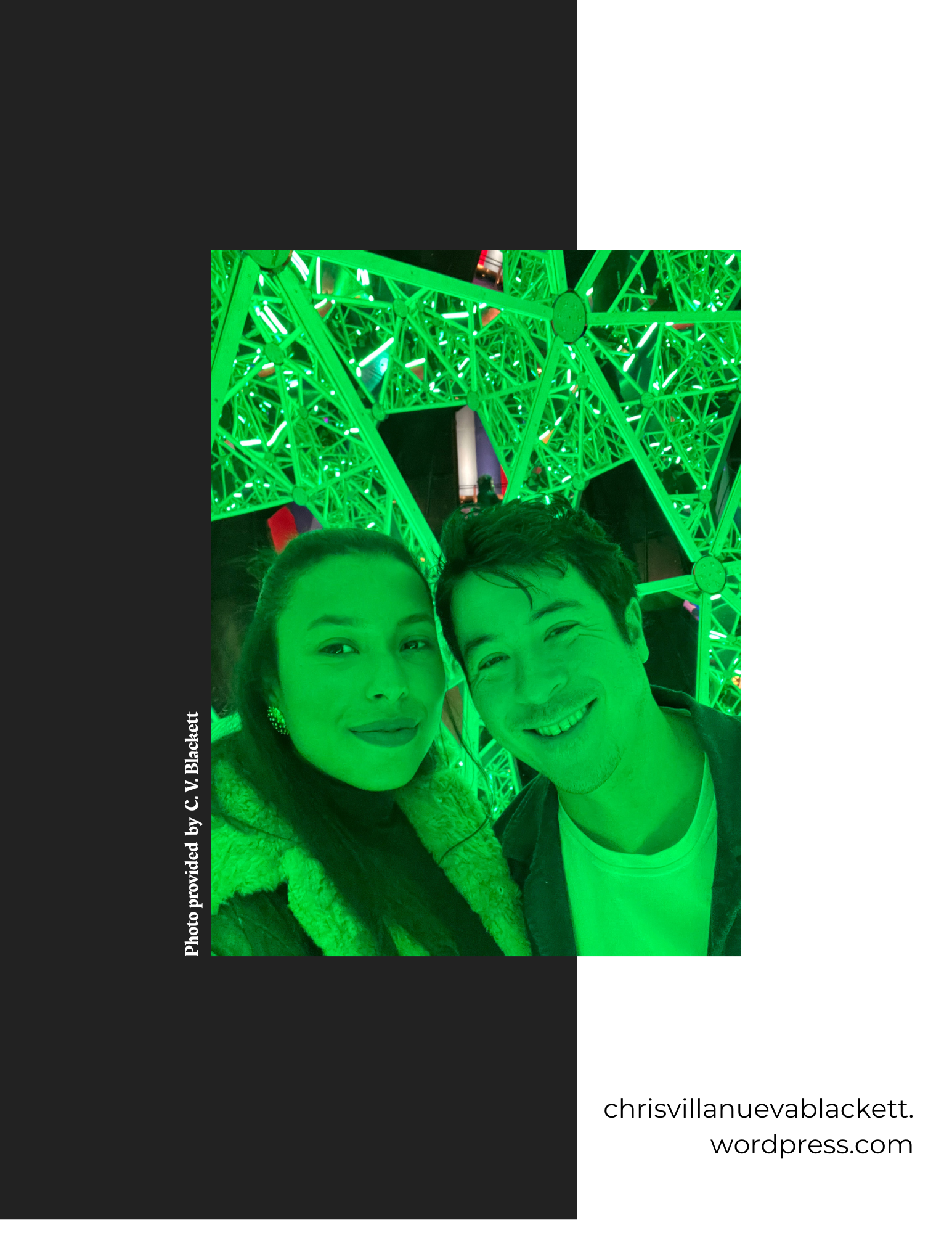
Christopher Villanueva Blackett is a native New Yorker, born to Filipino and English immigrants. His Pinay mother passed away when he was an infant, and his dad raised him with a deep appreciation for the escape that books provided.
His childhood bedroom doubled as his library, filled with Isaac Asimov and Terry Pratchett.
He studied English Literature at Tufts University. After graduating, he taught for several years in East Harlem with Teach for America.
Recently, he received his MBA/MPA from NYU, and now works in EdTech.
Growing up, he spent thirty-two summers visiting his titos, titas, lola, and his mother’s columbarium in Manila. Those experiences inform the characters and locales in his stories. He currently lives in New York City with his wife and two dogs.
DILIM: What are your earliest memories of writing or creating?
CVB: I was much more of a visual artist as a child–taking art classes at The National Academy and the Children’s Art League in New York City. It wasn’t until high school that I wrote my first piece of fiction.
I had an English Literature teacher who let us choose to write a paper or write a novella for a final project. I opted to write a novella. It was a terrible piece of fiction, but it made me fall in love with the act of writing prose, and it showed me that this was a craft–like any other–at which you can practice and get better.
DILIM: Do you have a favorite place to feel productive?
CVB: I’ve moved around a lot over the past few years, so I’ve become proficient at writing anywhere, from lying in my bed with my computer on my belly, to sitting hunched over my desk, to tapping notes out on the subway.
My favorite place to write, though, is at my desk facing our view of New York and the windowsill of plants that my wife lovingly nurtures.
My favorite place to write is at my desk facing our view of New York and the windowsill of plants that my wife lovingly nurtures. 🪴
DILIM: Which advice would you give to yourself from five years ago?
CVB: Put your writing out there.
Writing groups and receiving critiques are so important–but it’s also so important to submit your pieces to agents and take a chance, hear their feedback, and practice the art of writing queries.
I’m only at the beginning of this journey, just now submitting my pieces to magazines and sending queries to agents, but I wish I had started years ago. You learn by doing, and writing–much as we think it’s a solitary art–is a social one.
DILIM: What would you want the reader to remember, long after they’ve left the page?
CVB: I love leaving a book or story with a phrase or metaphor still ringing in my ears. Really powerful phrases connect you to ideas, and have longevity to them that often outsurvive a story…or help people remember that story.
I read Kevah Akbar’s Martyr! more than a year ago, but I still remember how he described a shopping mall as having a “corporate mercenary” energy. That stuck with me as a beautifully crafted phrase.
We forget so much of what we read, but we remember scenes or images, and those lead to feelings, and those feelings can pull us back to stories. With this publication, the title ‘Galleon Dreaming’ is so evocative, and lingers long after people will.
DILIM: What’s next for you in your creative process?
CVB: I’m currently working with an editor to refine a manuscript I’ve written, called Tumakas, about a monster stalking Manila. This novel has been a long time coming, and I wish past-me could read my advice above!
I queried the novel and got some great, motivating feedback, but I only wish I’d queried it earlier.
So right now, my priority is shaping that novel and getting it to a much better place, with the occasional break to write short fiction.
Follow Christopher at:
A note from Christopher: “I write an education-themed Substack called Talent Lab (less fiction, more critique on late stage capitalism through the lens of education)”